
BLOG
Types of Peptides
ago
Peptides
Peptides have exploded in popularity across health, wellness, and medical fields, but understanding the different types can be overwhelming. From skincare serums to research compounds, peptides come in many forms with distinct purposes, structures, and regulatory statuses.
This comprehensive guide breaks down the major types of peptides, how they’re classified, and what each category means for practical use.
What Exactly Are Peptides?
Before diving into types, it helps to understand what peptides actually are. Peptides are compounds formed by the condensation of two or more α-amino acids connected through peptide bonds—the same bonds that link amino acids in proteins . They sit in a structural middle ground: smaller than proteins but larger than individual amino acids.
Size matters in peptide classification. The National Library of Medicine defines oligopeptides as containing approximately 2 to 12 amino acids, while polypeptides contain roughly 13 or more amino acids . Proteins are considered larger versions of peptides that can fold into complex three-dimensional structures like enzymes and receptors.
Structural Classification of Peptides
Scientists classify peptides by their physical structure, which directly influences their stability, function, and applications .
Linear Peptides
Linear peptides have amino acids linked in a straight chain without cyclic connections. They’re the simplest structural form and are highly flexible in solution. Many signaling peptides and hormones fall into this category. However, linear peptides tend to be less stable and more susceptible to enzymatic breakdown compared to their cyclic counterparts .
Cyclic Peptides
Cyclic peptides form closed-ring structures through bonds between the ends of the chain. This circular configuration provides greater stability and resistance to enzymatic degradation, making them valuable for therapeutic applications. Common examples include cyclosporine, an immunosuppressant used in organ transplants .
Disulfide-Rich Peptides
These peptides contain one or more disulfide bonds (sulfur-to-sulfur links between cysteine amino acids) that create stable loops within the structure. Antimicrobial peptides like defensins and tachyplesins belong to this group. The disulfide bonds provide structural rigidity and protect against proteolytic breakdown .
Stapled Peptides
Stapled peptides are a newer class where a chemical “staple” connects two amino acids within the chain, locking the peptide into a specific, stable shape. This approach helps peptides maintain their bioactive conformation and resist degradation, with applications emerging in drug development .
Classification by Biosynthesis Method
How peptides are produced in nature or the lab provides another essential classification system. The biosynthesis machinery determines the peptide’s structure and potential modifications .
Ribosomal Peptides
Ribosomal peptides are synthesized through mRNA translation on ribosomes—the same process that creates proteins. After initial synthesis, these peptides often undergo post-translational modifications such as hydroxylation, sulfonation, or disulfide bridge formation to reach their mature, functional form .
In higher organisms, ribosomal peptides frequently function as hormones and signaling molecules . This category also includes ribosomally synthesized and post-translationally modified peptides (RiPPs), which can have complex cyclic architectures like lanthipeptides and thiopeptides .
Non-Ribosomal Peptides
Non-ribosomal peptides are assembled by dedicated enzyme complexes called non-ribosomal peptide synthetases (NRPSs), not by ribosomes . This biosynthesis pathway allows for greater structural diversity, including cyclic structures and the incorporation of non-standard amino acids.
The most common non-ribosomal peptide is glutathione, a critical antioxidant in most aerobic organisms . Other examples include lipopeptide surfactants, glycopeptide antibiotics, and various microbial natural products . Non-ribosomal peptides are particularly common in plants, fungi, and bacteria.
Classification by Bioactive Function
Peptides can also be grouped by what they do in biological systems. The NIH database of bioactive peptides categorizes them across 10 major functional groups including therapeutic applications, neurological activity, drug delivery, immunological function, and molecular binding .
Hormonal Peptides
Hormonal peptides act as chemical messengers that coordinate physiological functions throughout the body. Oxytocin and vasopressin are classic examples—both are nonapeptides (nine amino acids) produced by the hypothalamus . Oxytocin plays roles in social bonding and childbirth, while vasopressin regulates water balance and blood pressure.
Neuropeptides
Neuropeptides function in the nervous system as signaling molecules. Endorphins (“endogenous morphine”) are natural pain-relieving peptides that bind to opioid receptors in the brain. Dynorphin, a 13-amino-acid peptide, is notably potent in this class . Other neuropeptides like enkephalins regulate intestinal motility and pain perception.
Antimicrobial Peptides
Antimicrobial peptides (AMPs) defend against pathogens. They’re structurally diverse and can be categorized by their folding patterns:
- Type I: Linear α-Helical Peptides – These make up about 27% of known peptides. They’re highly positively charged, unstructured in aqueous solution, and fold into α-helical configurations when binding to bacterial membranes. Examples include magainin, cecropin, and LL-37 .
- Type II: Cyclic Peptides with β-Sheet Structure – These contain 1-5 disulfide bonds and maintain β-sheet conformation in aqueous solution. Tachyplesins, defensins, and protegrins fall into this category .
- Type III: Extended Peptides – Linear in shape without secondary structure, these peptides are often rich in a single amino acid type like proline, glycine, or histidine. Histatin and indolicidin are examples .
- Type IV: Looped Peptides – These feature a looped structure from a single disulfide, amide, or isopeptide bond. They’re short, easy to synthesize, and proteolytically stable .
Cosmetic Peptides: Topical Applications
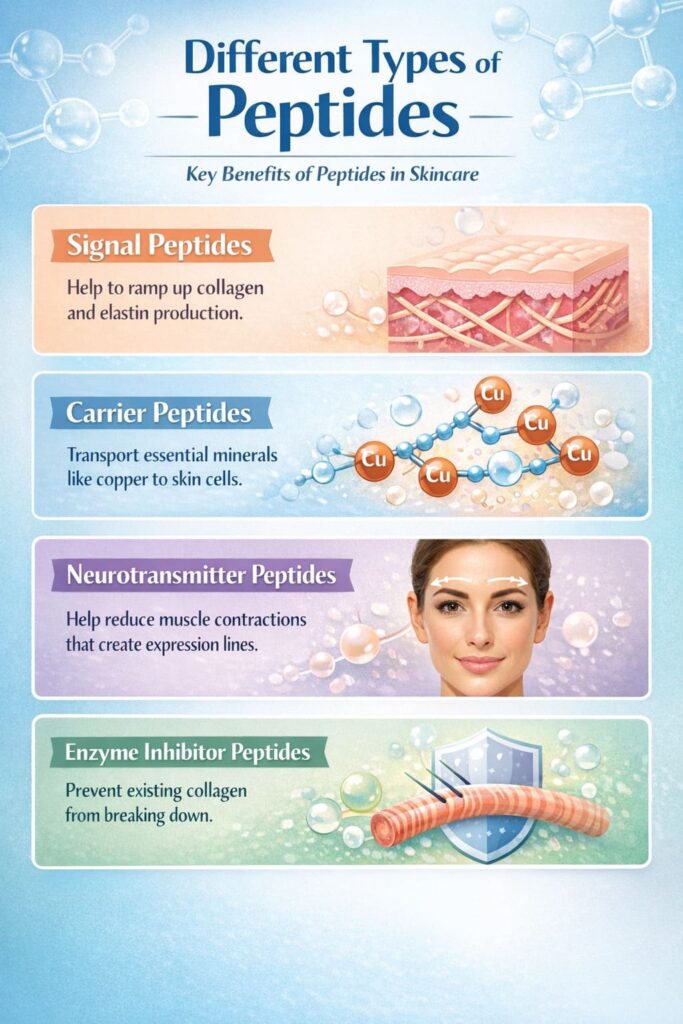
The skincare industry has embraced peptides for their ability to signal skin cells and support collagen production. Cosmetic peptides have distinct subcategories based on their mechanisms of action .
Signaling Peptides
These peptides act as messengers that “trick” skin into thinking it’s injured, prompting the production of new proteins like collagen, elastin, and laminin. Matrixyl (palmitoyl pentapeptide-4) is a well-known signaling peptide studied for its collagen-boosting effects .
Portador De Peptídeos
Carrier peptides transport essential trace elements (like copper and manganese) to target cells. GHK-Cu (copper peptide) is the most extensively researched carrier peptide, first isolated from human plasma albumin in 1973. Studies have shown GHK-Cu significantly increases collagen production—more effectively than vitamin C or retinoic acid in some research .
Enzyme-Inhibitor Peptides
These peptides inhibit enzymes that break down skin structure or trigger unwanted processes. They may block matrix metalloproteases (MMPs) that degrade collagen or tyrosinase, which stimulates melanin production and skin darkening .
Research and Performance Peptides
A class of peptides frequently discussed in fitness and research communities includes compounds that affect growth hormone pathways, healing, and metabolism. Notably, these are typically labeled for laboratory research use only and are not FDA-approved medications.
Injury and Recovery Peptides
BPC-157 has gained attention in recovery forums for its reported tissue-healing properties. TB-500 (a synthetic fragment of thymosin beta-4) is similarly referenced for muscle recovery applications .
Growth Hormone-Releasing Peptides
Several compounds influence growth hormone signaling:
- CJC-1295 – A synthetic compound that affects growth hormone pathways
- Ipamorelin and Sermorelin – Growth hormone-releasing peptides sometimes used in prescription settings
- GHRP-2, GHRP-6, Hexarelin – A group of compounds that stimulate growth hormone release
Metabolic and Longevity Research
Peptides like MOTS-C are studied for potential roles in metabolism and energy regulation, while Epitalon has been investigated for longevity-related applications .
Regulatory and Practical Considerations
Understanding peptide types also means understanding their regulatory status, as this determines accessibility and appropriate use.
Prescription Therapeutic Peptides
Some peptides are FDA-approved medications requiring a prescription. These include synthetic hormones, certain GLP-1 agonists, and other therapeutic compounds. They’re developed through rigorous clinical trials and regulated for safety and efficacy .
Cosmetic Peptides
Peptides in topical skincare are regulated differently from drugs. They don’t require FDA approval before marketing but must meet cosmetic safety standards. Common cosmetic peptides include GHK-Cu, Matrixyl, and palmitoyl-KTTKS .
Research-Only Peptides
Many peptides discussed in online forums are labeled exclusively for laboratory research, not human consumption. This includes most growth hormone-releasing peptides and experimental compounds . Legitimate research peptide suppliers sell these for in-vitro or animal studies, with appropriate labeling and documentation.
Dietary Peptides
Collagen peptides and other food-derived peptides are treated as nutritional supplements, with different regulatory oversight than therapeutic peptides .
Formulation and Bioavailability Considerations
For any peptide type to be effective, delivery matters enormously. Skincare peptides often require specific formulations to penetrate the skin. Acylation with fatty groups (like palmitoylation) can improve skin penetration by 100 to 1000 times . The product formulation itself matters—one study found palmitoyl-KTTKS stability varying from 99.9% to just 23.5% across different commercial anti-wrinkle creams .
For therapeutic peptides, challenges include rapid proteolytic degradation and poor oral absorption. Some approaches to improve stability include incorporating D-amino acids, N-terminal acetylation, and C-terminal amidylation . Cell-penetrating peptides (CPPs) like TAT and pVEC are being studied to enhance delivery across biological barriers .
Summary Comparison Table
| Classification Method | Major Categories | Examples |
|---|---|---|
| Structure | Linear, Cyclic, Disulfide-rich, Stapled | Cyclosporine (cyclic), Defensins (disulfide-rich) |
| Biosynthesis | Ribosomal, Non-ribosomal, Peptones | Glutathione (non-ribosomal), Hormones (ribosomal) |
| Function | Hormonal, Neuropeptides, Antimicrobial, Cosmetic | Oxytocin, Endorphins, Magainin, GHK-Cu |
| Regulatory Status | Prescription, Cosmetic, Research, Dietary | Semaglutide, Matrixyl, BPC-157, Collagen |
| Cosmetic Mechanism | Signaling, Carrier, Enzyme-inhibitor | Palmitoyl pentapeptide, GHK-Cu |
Final Thoughts
The diversity of peptide types reflects their remarkable versatility as biological molecules. Whether you’re interested in collagen supplements, skincare actives, therapeutic hormones, or research compounds, understanding peptide classification helps cut through marketing hype and make informed decisions.
When considering any peptide product, pay attention to:
- Regulatory status – Is it a prescription medication, cosmetic, or research chemical?
- Delivery system – How is it formulated for absorption or penetration?
- Scientific evidence – Does human research support the claimed benefits?
- Quality assurance – Are there third-party certifications or independent testing?
Peptides offer exciting potential across multiple domains, but their benefits depend entirely on using the right type, in the right way, for the right application.

 Português do Brasil
  English